
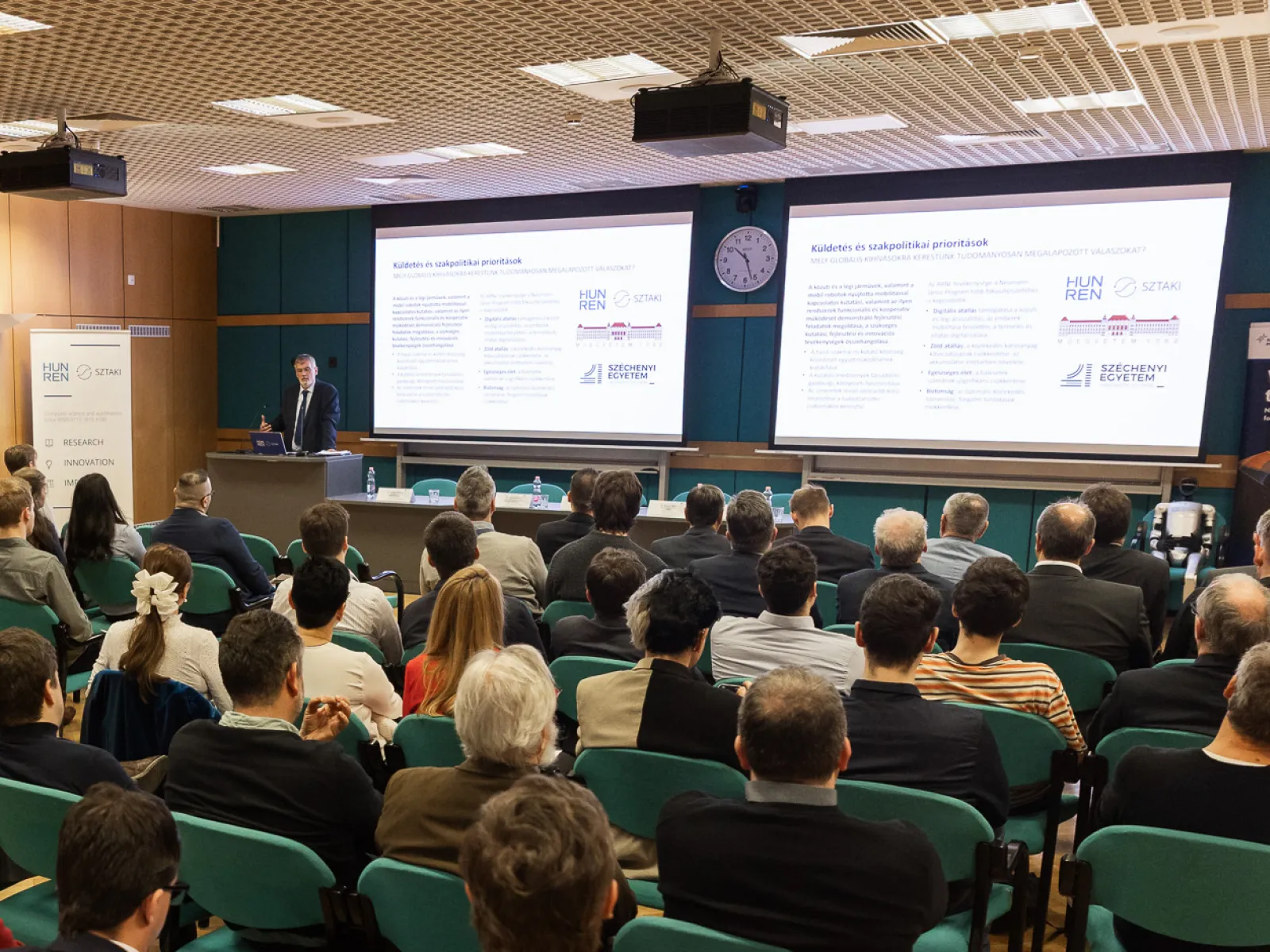
The research and development program of the National Laboratory for Autonomous Systems (NLAS) has been completed, which for more than four years has been investigating the safe, fast and sustainable operation of autonomous vehicles, robots and drones that operate without human intervention. The aim of the project was to make future transport and industrial systems more reliable, energy-efficient and safer for everyone.
The program, which started in the fall of 2021, has developed technological solutions that help self-driving vehicles and robots respond more quickly to unexpected situations, perceive their environment more accurately, and use energy more efficiently. These developments could contribute to reducing the number of traffic accidents, lowering harmful emissions, and increasing the competitiveness of the automotive and robotics industries.
The impact of the research is significant not only from a scientific point of view, but also from a social and economic perspective. During its operation, NLAS has generated total revenues of more than HUF 9 billion. As a result of the program, 13 domestic patents and trademarks and 4 international patents have been filed to date, and 3 spin-off companies have been supported, which put the knowledge generated in the Laboratory into practice.
The project was implemented with a non-repayable grant of HUF 6.2 billion from the European Union under the RRF-2.3.1-2021 call entitled "Establishment and complex development of a national laboratory". Three key institutions – HUN-REN SZTAKI, Széchenyi István University and the Budapest University of Technology and Economics – participated in the work, with the involvement of nearly 400 researchers and technicians.
"The National Laboratory for Autonomous Systems was a true community achievement. It resulted in a collaboration between researchers that produced tangible technological results and laid a strong foundation for the long-term development of autonomous vehicles and robotics in Hungary," said Péter Gáspár, head of the Systems and Control Research Laboratory at HUN-REN SZTAKI, which provided professional leadership for the NLAS.
"NLAS was not only a research project, but also a knowledge-building workshop. During the program, hundreds of engineers, doctoral students, and students were involved in the development of state-of-the-art autonomous technologies. This has strengthened the next generation of professionals, ensuring that Hungary will remain competitive in the long term in the field of autonomous vehicle and robotics technologies," emphasized Ferenc Szauter, associate professor at Széchenyi István University and head of the Vehicle Industry Research Center.
"Within the framework of NLAS, we not only conducted research, but also created autonomous technologies that are immediately understandable and applicable to industry. This program has built a bridge between university research and the economy. A tangible result of this is the creation of three spin-off companies, which are already generating significant revenue and carrying on the knowledge accumulated in NLAS," emphasized Zsolt Szalay, associate professor and head of the Department of Automotive Technologies at the Budapest University of Technology and Economics.
The conclusion of the NLAS project does not mark the end of a process, but rather the beginning of a strengthened innovation ecosystem. "As a result of the research work, the technologies and collaborations developed in the project will contribute to making the transportation and industrial systems of the future safer and more efficient for everyone," added Péter Gáspár.